

Geological Landscape of Dolomites
From Ocean To The Mountains: Geological landscape of Dolomites
The geological history of the Dolomites is very precisely. These mountains have determined the variety of landscapes and the contrasts of colors and shapes. The presence of rocks are compact like the dolomites are accompanied by that of conglomerates and to hold thick clays sedimented around the giant towers. The intense volcanic phenomena like Col Di Lana occurred in times and in different areas, these volcanic mountains originated the accumulations of dark rocks that now form the gentle slopes covered by green. A very ancient story that can be started by the Permian era, around 280 BCE. The creation of this type of carbonate rocks begin with accumulations of shells, corals and calcareous algae and in a marine and tropical environment, which took place in the Triassic era, around 250 millions of years ago, in areas with latitude and longitude were very different from the current location of the Dolomites, where warm and shallow seas existed. On the bottom of these seas hundreds of meters of sediment were accumulated under their own weight and losing their internal fluids, turned into rocks. Subsequently, the clash between the European plate and the African plate (Alpine orogenesis) made these rocks emerge, raising them over 3000 m above sea level. From a genetic point of view, the Dolomites are classified into 2 parts; primary and secondary "Primary", generated by the direct precipitation of Calcium and Magnesium Carbonates in aevaporitic environment of shallow and warm water.
"Secondary", deriving from the replacement of calcium ions with magnesium ions during the sedimentation of the respective carbonates, in a high energy environment. (Coral reefs)
Dolomites are less soluble than calcareous rocks and therefore more resistant to agents erosive, the different type of degradation of the dolomite with respect to the other geological formations at the origin of that particular landscape called "Landscape of the Dolomites". From the geological point of view, the Dolomites are distinguished according to the Age of their formation that is occurred during the Triassic Period, between 250 and 210 million years ago, at the beginning of the Mesozoic Era. The shallow waters of the Triassic, which alternated with the cliffs, were characterized by soft rocks, like marl and marl limestone: the so called “San Cassiano Formation” 230 million years ago in Carnic era, where extremely well preserved fauna fossils are found in this layer and outcrops abundantly in several parts of the valley.Summarizing, the dolomitic orogenic history is as follows:
270-235 million years ago sedimentary rocks accumulate on land and at sea. Atolls and coral reefs are formed, often upset by volcanic eruptions;
235-180 million years ago, limestones and dolomites accumulate at the bottom of flat and coastal lagoons;
180-80 million years ago, deep seas allow the accumulation of limestones and marls in thick layers,
20 million years ago mountains were born through the deformation of the ancient sea beds. The African plate clashes with the Eurasian plate by raising the Dolomites (for example the Sella Group that stands for almost a thousand meters on the surrounding landscape was a single large coral reef).
The current landscape is angular and rich in gradients. This transformation was caused by the bending and breaking of rocks along sliding planes (faults), whose movements correspond to as many earthquakes; episodic volcanic explosions and related deposits; differential erosions linked to atmospheric agents and to the weaknesses inherent in the rocks. The result is a very articulated topography in vertical structures (shovels, spiers, towers, pinnacles, teeth, bell towers) and horizontal (roofs, cornices, terraces, ledges, plateaus). One can observe the evidence of periods with a temperate climate, prior to the glacial ones, but above all they dominate the forms of erosion and accumulation linked to the glacial periods, rocky humps smoothed and streaked with ice (mountainous rocks), suspended valleys, glacial cirques, deposits of moraines, traces of ancient frozen soils (permafrost), evidence of the pressures exerted by the glacial masses. The Dolomites are still rising and breaking. It shows the whiteness of coral reef carbonates, the sharpness of rocks and natural factors like glaciers, wind, rain and cold-heat, these factors increase erosion risks and change the shape of rock formations. In the geological future, the Dolomites will continue to grow by incorporating new sectors of rocks driven by the clash between the European and African plates. The process is similarly to what happens for the Himalayan chain. The disappearance of this push will determine the prevalence of exogenous agents tending to smooth out and soften the mountain landscape. The area of Cortina is one of the most evocative Dolomite landscapes in which the sequence of rocks, over 3,000 metres thick, covers a period from 270 million to 25 million years ago. Here the mountains tell the story of the Triassic archipelago, providing insights into the geometry of the islands with their inner lagoons and the relationship between the islands and the deep-sea sediments that surround them. These are manly fossils with the remains of plants, fish, metazoans, ammonites and reptiles.
The Lagazuoi, Col dei Bos and Tofane area contains continuous layers of rocks that make it possible to reconstruct the Carnian environments and that document the end of the Dolomite archipelago. Fossil amber containing some of the oldest insects and mites have been found among these layers. Among the other finds are dinosaur footprints and the skull of a stegocephalian amphibian. The Fanes and Sennes areas feature extensive plateaux, their contours modelled from calcareous rocks of the late Triassic and Jurassic/Cretaceous periods. In this part of the Dolomites are possible to trace the terminal phase in their marine history, marked by the transition from a widespread shallow sea to a deep pelagic seabed gradually filling up, subsequently to be raised up by the beginning of the Alpine collision. The youngest of the Dolomite rocks, formed 25 million years ago, are found here, in Monte Parei and Col Bechei, before their complete emergence from the sea, the Dolomites were still retained the residue of that sea with scattered areas of raised land, the Alpine foothills, with a rugged coastline that sometimes took the form of steep cliffs towering over the sea.
The geomorphology of Ampezzo Dolomiti reflects the structural rock formations. The landscape in the central part is dominated by the plateaux of Fanes and Sennes, with outcrops of calcareous limestone and younger marly rocks of the Jurassic-Tertiary period, while the peripheral areas contain mainly isolated massifs, ridges and rugged mountain chains, such as Settsass, Tofane, Croda Rossa d’Ampezzo, Monte Cristallo, Picco di Vallandro, Sasso del Signore and Monti Muro, sculpted from the varied and complex sequence of rocks produced during the mid and late Triassic period. The orientation of all the deep valleys that run across this area is dependent upon a complex network of thrust faults, in the Val Foresta, Valle di Braies Vecchia, Val di Fanes Grande, Val Padeon, etc., and sub-vertical faults, in the Val Boite, Val di Travenanzes, Val di Rudo, Valle di Fanes, Vallon Bianco, Val Salata, etc., some of which are still active. The prism-like geometry of the towering Principal Dolomite ramparts of mounts Cristallo and Tofane reflects the lay-out of the tectonic fractures. Examples of this are planar forms or shallow inclines such as ledges, balconies and small plateaux formed by selective erosion occurring where the lithological variation within the sequence is most marked.
The Fanes and Sennes plateaux are home to the most complete array of karst and glacio-karst phenomena in the whole of the Dolomites, both on the surface and underground. Lakes such as Lago Grande di Fosses, Lago Secco di Fanes Piccola and Lago di Limo sit on depressions of glacio-karst origin. There are widespread glacial morphologies including hanging valleys, cirques, step formations and sheepbacks. Less evident are the late-glacial and Little Ice Age banks of moraine that embellish the contours at higher altitudes. Lobes of moraine led to the formation of some lakes such as Lago Paron and Lago di Misurina. A glacial deposit, Col Bechei, has been discovered in the Fanes area and, in Limo Pass, there are conglomerates that precede the last Ice Age. Small glaciers are still active on mounts Cristallo and Croda Rossa d’Ampezzo. Extensive debris fields and cones border the foot of the vertical walls, particular those made of Principal Dolomite rock, of mounts Tofane, Cristallo, Conturines and Croda del Becco. In the area of Braies, in Armentarola and in Ru da Voi, these deposits feed major debris flows. The eastern slopes of Croda Rossa d’Ampezzo contain significant active rock-glacier cirques, the subject of much research. Landslides due to collapse and landslips along a stratum are most common in this part of the Dolomites. At the beginning of the late Glacial and early Holocene periods, major rock avalanches occurred, one of them damming the Valle di Braies thus forming the lake of the same name.

Geological map of Dolomites
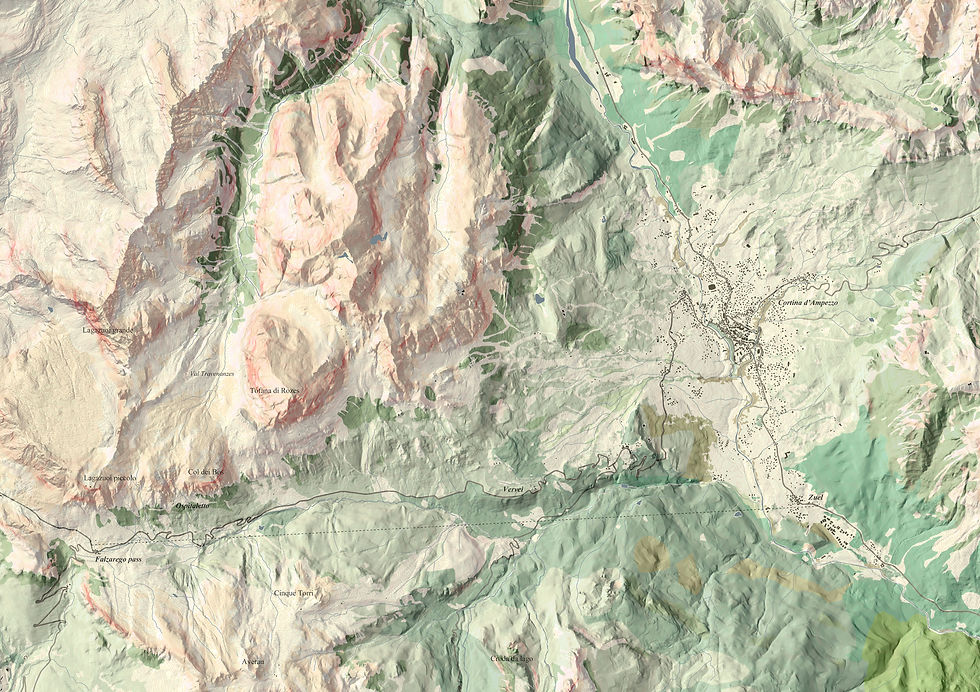
Ecological map of Ampezzo Dolomites

Geological map of Ampezzo Dolomites
Geological and anthropological changes in Ampezzo Dolomites
Shepherd is waiting the flock


View from Tofana di Rozes
View of Tofana di Rozes